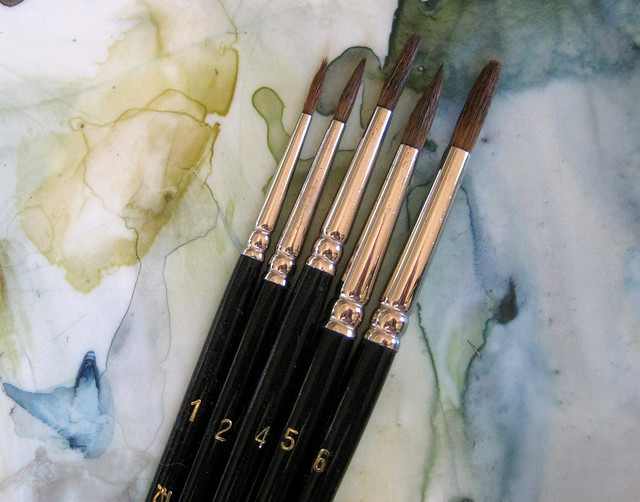
Brushes are your tools for painting.
Using the best quality brushes will yield better results.
So, how do you choose? Your selection will be made by these four factors:
medium, material used to make the brush, shape and size.
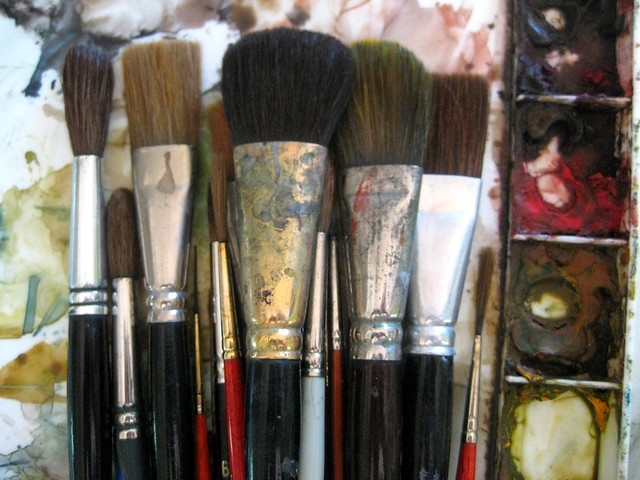
First, you need watercolor brushes.
Oil, acrylic and craft brushes are made for a
different purpose and are not suitable for watercolor.
I prefer to use kolinsky red sable brushes made from
the soft tail hairs of the siberian weasel.
They are expensive brushes but well worth it because
the natural coat and taper of the hairs holds the paint
really well and they maintain their shape
and point much longer with proper care.
If you prefer not to use animal hair
or would like more economical brushes,there are
wonderful synthetic watercolor brushes
that you can use as well.
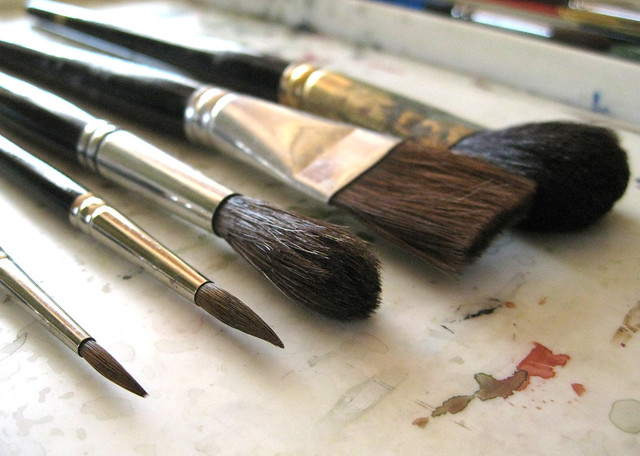
Brushes come in all different shapes and sizes.
You will want to be able to make a variety of marks
from very large washes to fine little details.
Brushes are numbered to correspond with size
from small to large. Every brand is slightly different.
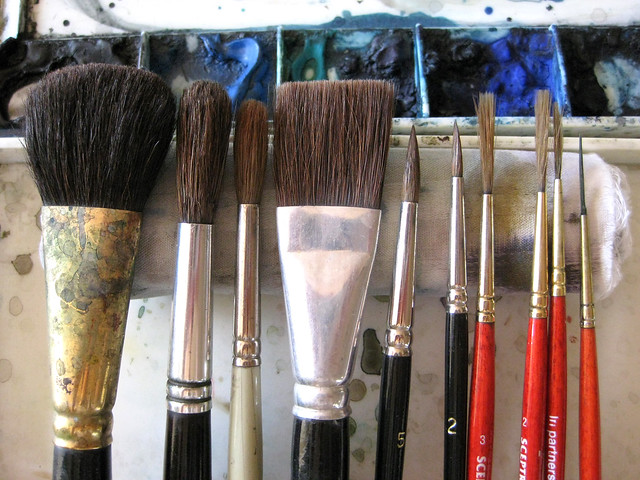
Honestly, you really only need five brushes to get started.
It's nice to have more, but they are not necessary
and you can always add to your collection.
I would recommend starting with one large round or
oval brush for big washes, one large or medium flat brush
for washes and painting a straight edge,
one medium pointed round and one small pointed round
for finer brush strokes,and a rigger or liner brush,
which makes a beautiful fine line.
The rigger is my favorite brush.
I have them in several sizes.
Every brush has this basic anatomy:
a handle, a ferrule, and a brush head.
When looking for a brush, these three parts should fit
tightly and seamlessly together. A new sable brush head
will be stiffened with gum arabic to hold its shape
and it will need to be rinsed in cool water before using it
for the first time.The hairs should not appear
misshapen, frayed, split or crooked.
With proper care your brushes will last a long time.
I have ruined quite a few brushes over the years
and my dog has chewed a few handles much to my dismay
(see the picture above).
Here are a few tips for keeping your brushes in good condition:
Don't use your brushes for anything but watercolor paint.
When you are working, gently mix your paint by swirling
and rolling the brush through it, don't smash the tip
into the paint or it will quickly fray and lose its shape.
Don't leave your brushes soaking in water as this will
loosen the handle and ferrule, not to mention
that the brush head will become misshapen.
I rest my brushes on a little rolled up rag next
to my palette while I am working.
 Rinse your brushes in cool water when you are finished
painting for the day. Remove paint residue from the brush
and ferrule and tease out any loose hairs. Pat dry and
reshape the tips of your brushes with your fingers.
Rinse your brushes in cool water when you are finished
painting for the day. Remove paint residue from the brush
and ferrule and tease out any loose hairs. Pat dry and
reshape the tips of your brushes with your fingers.
Store your brushes in a container or rest them on a
ledge or in a brush holder so that the brush heads
are not resting against or touching any surface.
You can also use a brush soap or a very mild soap
to thoroughly clean your brushes, but you don't want
to strip the oils from the natural brushes
by doing this too often.Synthetic brushes are less
fragile and a little easier to clean.
Places to shop for watercolor brushes:
Do you have any questions about watercolor brushes?
Experiment and see what works for you!
Next time 101 is all about paper.